
New prime editing technique inserts DNA sequences up to 12.5 kilobases without breaking strands
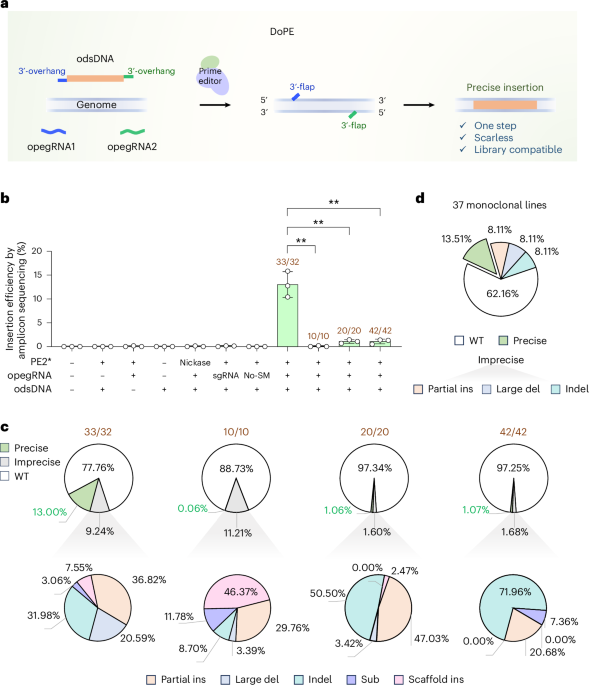
Researchers have developed donor-complementary prime editing (DoPE), a technique that inserts DNA fragments as large as 12.5 kilobases into genomes without creating double-strand breaks. The method combines a 3'-overhang double-stranded DNA donor with a pair of overhang-complementary prime editing guide RNAs and a PE2* prime editor enzyme. Published in Nature Biotechnology, the work shows how one opegRNA pair and donor pools built from synthesized single-stranded oligonucleotides can enable in situ saturation mutagenesis across a targeted EGFP region. The team also replaced mutant exons of PRKCSH to correct diverse mutations. DoPE supports insertions ranging from small fragments to those exceeding 10 kilobases.
The method lets researchers insert genes at scale in a single step, using standard library workflows. No recombinases or transposases required. It corrects different mutations the same way, in the lab dish.
Written by the Genomes desk from the primary source cited and linked above and checked against it. Research use only; not medical advice. Corrections: [email protected].