
Prime assembly integrates DNA sequences into human cells without double-strand breaks
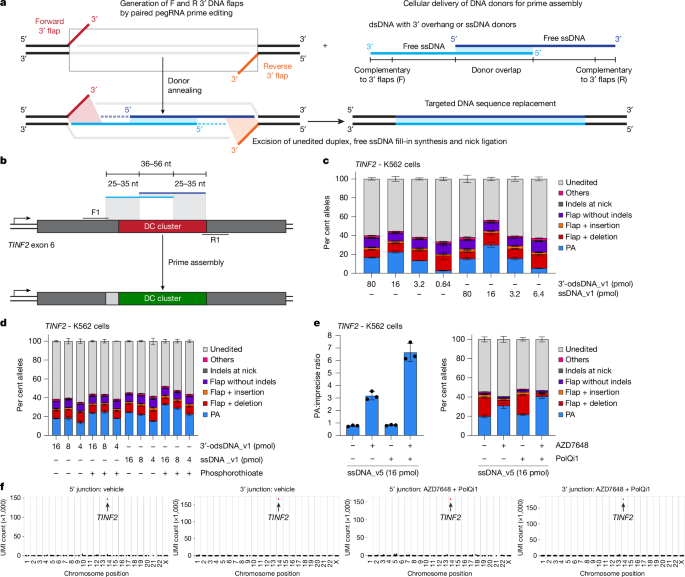
Prime assembly, a CRISPR-based method reported in Nature, integrated medium to large DNA sequences into human cells. It did not rely on double-strand breaks. The authors reported RNA-programmed, site-specific integration of single or double-stranded DNA fragments through targeted dual flap synthesis. Unlike homology-directed repair, it was similarly active in dividing and non-dividing cells. The team applied it to exon recoding, transgene integration and megabase-scale rearrangements, including at therapeutically relevant loci in primary human cells.
Gene-therapy developers may gain a way to place larger DNA edits in non-dividing human cells, though this is laboratory work, not a clinical tool.
Written by the Genomes desk from the primary source cited and linked above and checked against it. Research use only; not medical advice. Corrections: [email protected].